

Rx: Curiosity.
The moment just before the nervous system leaves the room. Part III.

The detachment series has one more thing to say. This time, for the ones who never needed to be taught how.
← If you’re new here, the essay this one responds to lives here:

⤵︎
I felt this one coming.
A short one, this time.
A lovely member of The Reset Room asked anything for the avoidants? after the last essay dropped, and I felt the thread immediately. Maybe you did, too.
Anxious grip is simply the loudest pattern in the room, so that’s where we went first.
But she has been here too, reading: keeping the door slightly ajar, moving through rooms lightly, having built a life that looks remarkably like self-sufficiency from the outside ~ and knowing, in the most honest hours, that it cost her something she has never quite let herself look at directly.
The avoidant and the anxious gripper share the same original wound.
The shape just looks different.
Where the gripper reaches and monitors, rehearses conversations she hasn’t had yet and replays the ones she has, the avoidant reorganized around appearing not to need anyone at all.
She learned early that needing people carried a cost. The scanning went inward, and the vigilance became self-directed. What emerged was a woman who can hold a room, hold her own, and everyone else together yet has almost no practice allowing herself to be held.
It appears as the hunger she learned to call contentment, always surfacing at the threshold of real intimacy, and the ceiling she places on connection precisely when it starts to feel like it might really mean something.
I write about this because I watch it stall healing. Many years in clinic, I’ve seen women do “everything right” and still circle the same place. The cost of this pattern is less obvious than the more anxious tendency.. more in the slow realization that she has been the most consistent person in every room she’s ever been in, and somehow still the least known.

The avoidant system rarely lacks feeling.
It lacks permission to stay long enough to learn what the feeling itself contains.
Rx: I feel this. is the fuller work here because the exit reflex moves so fast, so practiced and beneath the surface, that by the time she could note what rose in her chest she is already somewhere else entirely ~ in a different room with a reasonable explanation, Shen/spirit searching for ground it learned early was unstable.
It worked once. The nervous system is not wrong for learning what kept her safe.
The exit became more reliable than the landing.
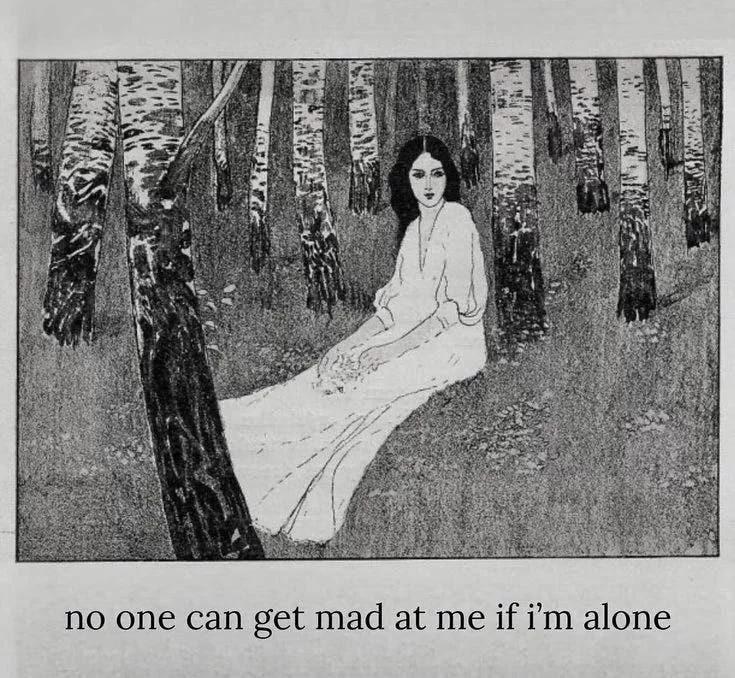
Speed.
The feeling rises and the system accelerates past it.
The person across the table wonders where you went. It might even make them anxious. ⋆˚࿔
Rx: Curiosity
Curiosity asks her to turn this question inwards: what was happening in my body in the moment just as I was leaving?
That sensation ~ chest closing, jaw tightening, slight unreality, and sudden very compelling need to be somewhere else ~ that is the thread.
𓍯𓂃
And it goes somewhere.
What feels like irritation often softens into fear when you stay with it.
And what reads as the need for distance turns out to be grief arriving in its oldest disguise.
Pull the thread gently (too), with genuine interest rather than the clinical distance she’s probably already reaching for as she reads this. I can feel it.
Stay in the room with the question a little longer than feels comfortable.
That’s the move.
“Curiosity comes out of a sense of safety; rigidity out of being vigilant to threats.” — Sue Johnson, Hold Me Tight

Curiosity lives in the space between I feel this and I am not this.
For the anxious it asks: can I stay with this sensation without immediately writing a story around it?

For the avoidant it asks something simpler and harder: can I stay.
Oh. There you are. What are you made of?
Curiosity > acceleration
That question, held with genuine interest ~ softness rather than agenda ~ is a nervous system regulation tool as real as anything I’d prescribe in clinic.
The body responds to being met with curiosity the way it responds to being held.
Something in the shoulders release. The Shen settles.
When you want to shut down, loosen just enough to let something true come through.
As the exit reflex rises ~ the sequence follows…
Name it: this is my nervous system leaving. One hand to chest. The other hand to belly. One slow breath, longer out than in. Stay in the room a little longer than feels natural. Then ask: am I leaving from wisdom or from fear?
The oxytocin protocol from the last essay applies here too. The tools are the same even if the entry point is different.
And when curiosity has had a moment to settle ~ consider this the next small step.
Vulnerability. Yes. When you stop accelerating past the feeling long enough for it to be witnessed, even just by you, there is an opportunity for healing expansion there. Try it in the smallest possible increment. I don’t mean the conversation you’ve been avoiding for years…just let something be true without immediately managing it.

Rx: Let it be seen. Start with yourself.
And when she does ~ even once, even briefly ~ something shifts.
The person across the table stops being a threat.
The room stops being a place to escape.
She becomes,
for a moment,
someone who can be known.
(P.S. You can replace she. This applies to anyone, really.)
ᥫ᭡.
I want to drop an herb here that comes to heart for you if this resonated with you:
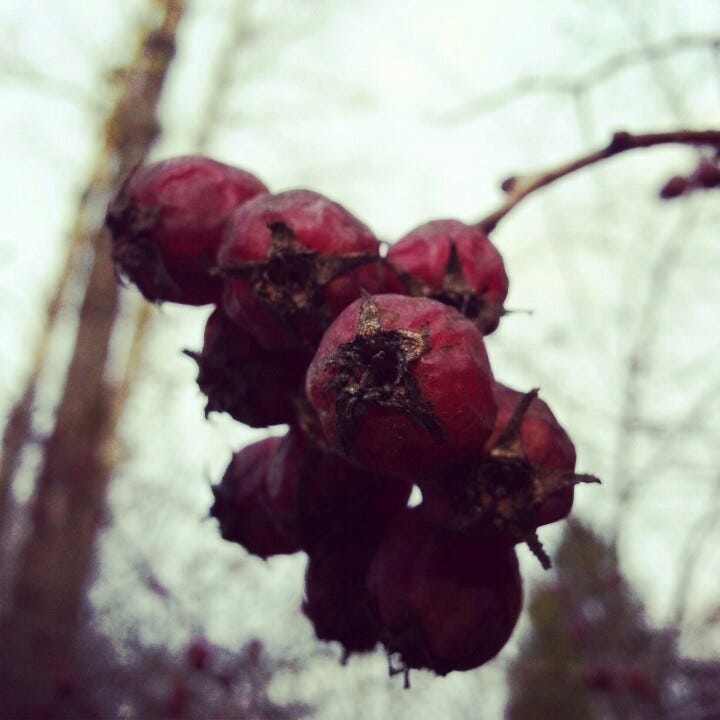
Hawthorn berry. This is one of my favorite “heart herbs” in both Western and Eastern traditions. Tonifies Heart Blood by nourishing the capacity for connection, the vessel that holds feeling rather than deflecting it. It also moves the grief that was never expressed, which is often what lives underneath the avoidant pattern. This herb digests food and emotions. It’s especially useful for those who feel tender in the gut when it comes to relational matters.
There is something fitting about prescribing a berry that grows behind thorns.
I could write an entire essay on hawthorn alone.
If you’d like a few more plants for this terrain, I’ve placed them below the fold.
“These pains you feel are messengers. Listen to them.” — Rumi
Stay. Curious. What was happening in the body in the moment just as you were leaving? Sit with it. It goes somewhere. 🍃
This essay grew out of the Ramadan Is a Masterclass in Detachment essay, which is fitting. Ramadan has a way of surfacing exactly what we've been managing instead of feeling.
