

Ramadan Hydration: Uncommon Tips for Every Body (Yes, Nursing Mamas, Too)
A Reset Room Q&A on fasting, nursing, and the body’s hidden water reserves

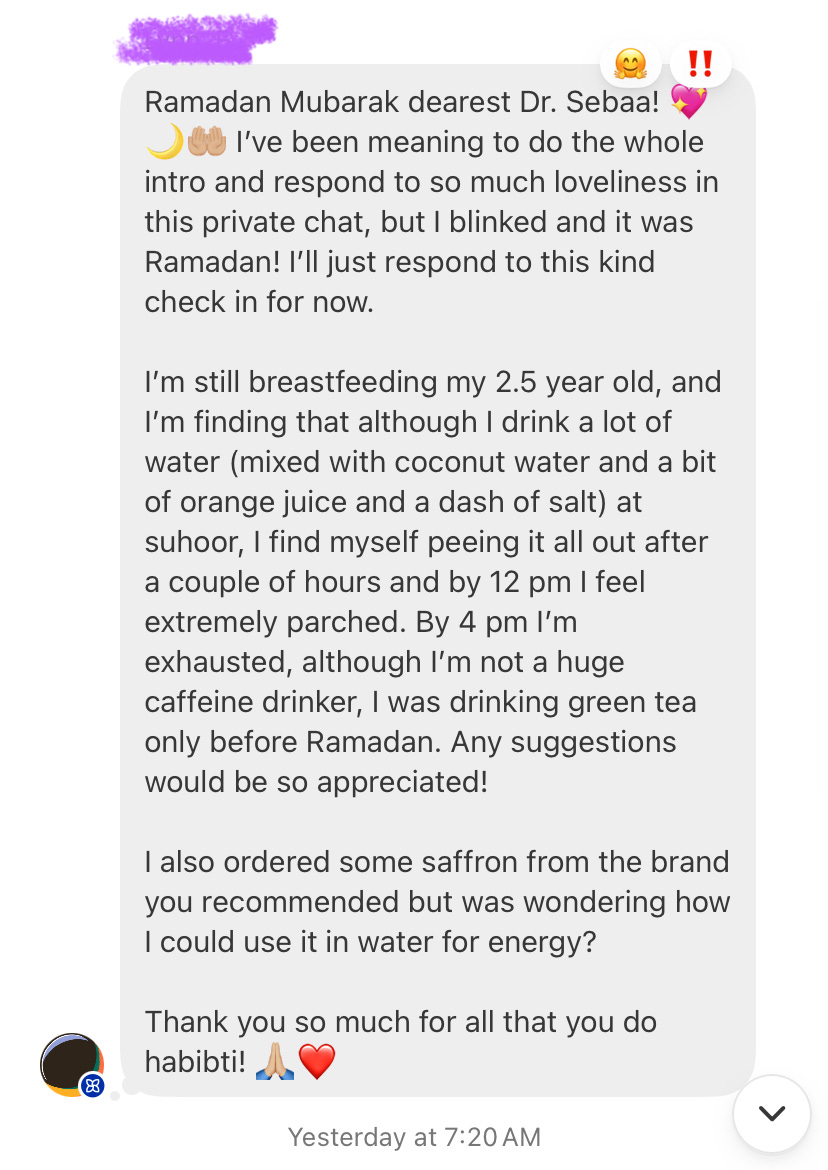
Ramadan Mubarak to all who observe. This Q&A arrived from a beautiful mama in The Reset Room nursing her 2.5-year-old through the fast, reaching for coconut water and salt and still losing the battle by noon. I knew the moment I read it that her question was living in many bodies at once, whether you’re nursing or not. So I’m expanding my response here for her, and for everyone navigating the alchemy of dry fasting, faith, and a body that still has needs.
I covered breastfeeding during Ramadan in this video from a different angle a few years ago. It pairs well with what follows if that’s your situation right now.
Q:
A:
I want to address this through several lenses I work from (TCM, functional medicine, bioenergetics, and sunnah) because no single framework holds the whole picture. And I want to start with what water is, because most of us don’t really stop to thinking about that, and it’s something I need, too.
I. A Note on the Water Itself
Spring water moves. It spirals through rock, gains mineral charge, and picks up electrons from the earth. That motion ~ that vortex ~ changes the molecular arrangement of water in ways that make it dramatically more bioavailable at the cellular level. Gerald Pollack’s research at the University of Washington describes what he calls EZ water (exclusion zone water): a fourth phase of water, liquid crystalline, structured, gel-like, that lives inside healthy cells and fascia and around proteins. It’s the water your body uses most effectively.

Much of what we drink today is what I call “flat” - processed, filtered, and stored in ways that strip minerals and may alter its natural structure (think: reverse osmosis, plastic bottles, and municipal pipes.) The body can absolutely use it, but the context is different from water moving through mineral-rich earth, and whether that difference matters physiologically is a question worth sitting with.
Some of this will sound like woo. I understand that. But this is also physics. Quantum biology. Pollack’s work has been published, studied, and is increasingly taken seriously in bioenergetics circles, though I want to be clear: the leap from his lab findings to structured water devices is not yet supported by strong independent clinical replication. This territory is genuinely controversial. I’ve been skeptical myself (that’s just part of how I practice, I question everything) but I was gifted a tool called an Analemma wand and have been studying my own response to it on an n=1 level. The principle: swirling water with a wand containing mother water already in coherent, crystalline state is said to reorganize the water around it into that same structure. A few swirls, and the water tastes different to me (and others who’ve tried it) in a slightly sweeter way. I notice something. I can’t tell you what that something is with clinical certainty, and I won’t pretend I can. What I can say is that I keep doing it, and I keep being curious about it. Explore it with that same spirit if you’d like: open, questioning, and unattached.
I say bismillah before I swirl it. I’ve started adding a moment of intention before drinking any water (swirl or not.) Al-Fatiha if I have the presence for it. This may feel peripheral to some and essential to others, but what we do know is this: stillness + intention before drinking activates the parasympathetic nervous system, and digestion is a parasympathetic function. How the gut receives what’s offered changes depending on the state you’re in when you drink it. Sunnah tells us to drink in three sips, seated, with the name of God. Whatever your framework, the physiology of that practice is sound.

If a wand feels like too much (I get it), consider: store water in glass or a copper vessel, not plastic. Add a pinch of high-quality sea salt (I’ve been liking this California coast flake salt) and fresh lemon/lime and let it sit. Movement may help ~ agitating water transiently alters its structure, though the clinical significance of this is still being explored. Local spring water, when you can find it, carries minerals its source. And produce from your local farmers’ market - citrus from the groves near where you live, roots from soil that carries this season’s sun - brings a vitality that bottled water simply cannot replicate. Local produce reflects the mineral and sunlight patterns of the environment it was grown in, which may partly explain why the body often responds differently to it.
II. Why You’re Peeing It Out
Your instinct to add coconut water, OJ, and salt is sound. You’re reaching for electrolytes, and that’s right, but the volume moving through quickly points to an absorption problem, not a volume problem.
From a circadian lens: vasopressin (the hormone that signals the kidneys to conserve water) peaks overnight and drops as morning approaches. Suhoor lands right in that transition window. You’re drinking at the moment your body’s natural retention capacity is already winding down. Volume at suhoor, without the carrier mechanisms to slow absorption, tends to pass through.
A note on the OJ specifically: in larger amounts, or without fiber, fat, or a carrier, fructose at suhoor can increase diuresis (the kidneys process that sugar load and water follows.) Small amounts paired with sodium may actually support absorption via glucose transporters ~ so it’s less about avoiding citrus entirely and more about how you’re taking it. If you want citrus at suhoor, pair it with pulp, basil seeds (> chia seeds, more on that below), or fat (like olive oil or coconut oil). That changes the absorption kinetics entirely. Save the straight juice for iftar, alongside something like blood oranges that are at peak right now in Southern California. ;)
From a TCM and functional lens: what you’re describing by noon is an acute yin depletion pattern that emerges from situational demand, not necessarily underlying constitutional deficiency. Dry fasting depletes. Breastfeeding a toddler depletes continuously, pulling fluid directly into milk production. ^Two yin-consuming forces running at once. The parched mouth, the 4pm exhaustion that feels like your reserves are being drawn on is your body saying something. This is normal Ramadan physiology amplified by lactation, and naming it accurately matters, because it changes how we respond to it.
III. Gel Water: The Missing Carrier
Water absorbed slowly, held in a plant matrix, is absorbed differently by the gut than water from a bottle or cup. It releases gradually, moves through fascia rather than flushing straight to the kidneys. This is what Quench (Dana Cohen, MD) calls structured or gel water, and it’s what traditional fasting cultures have always relied on without noting it that way.
Desert peoples intuitively “ate their water” through things like aloe vera gel, cactus pads (nopal), watery fruits, and nutrient-dense broths from camel milk or goat fat. These gel-like sources delivered electrolytes and bound moisture during arid, fasting-like conditions, preventing dehydration without excess fluid loss ~ much like Ramadan suhoor strategies for sustained energy.
In TCM terms, this aligns with nourishing jin ye (body fluids) via yin-supporting foods that replenish essence gently, fostering fluid balance and somatic resilience rather than relying solely on free-flowing liquids.
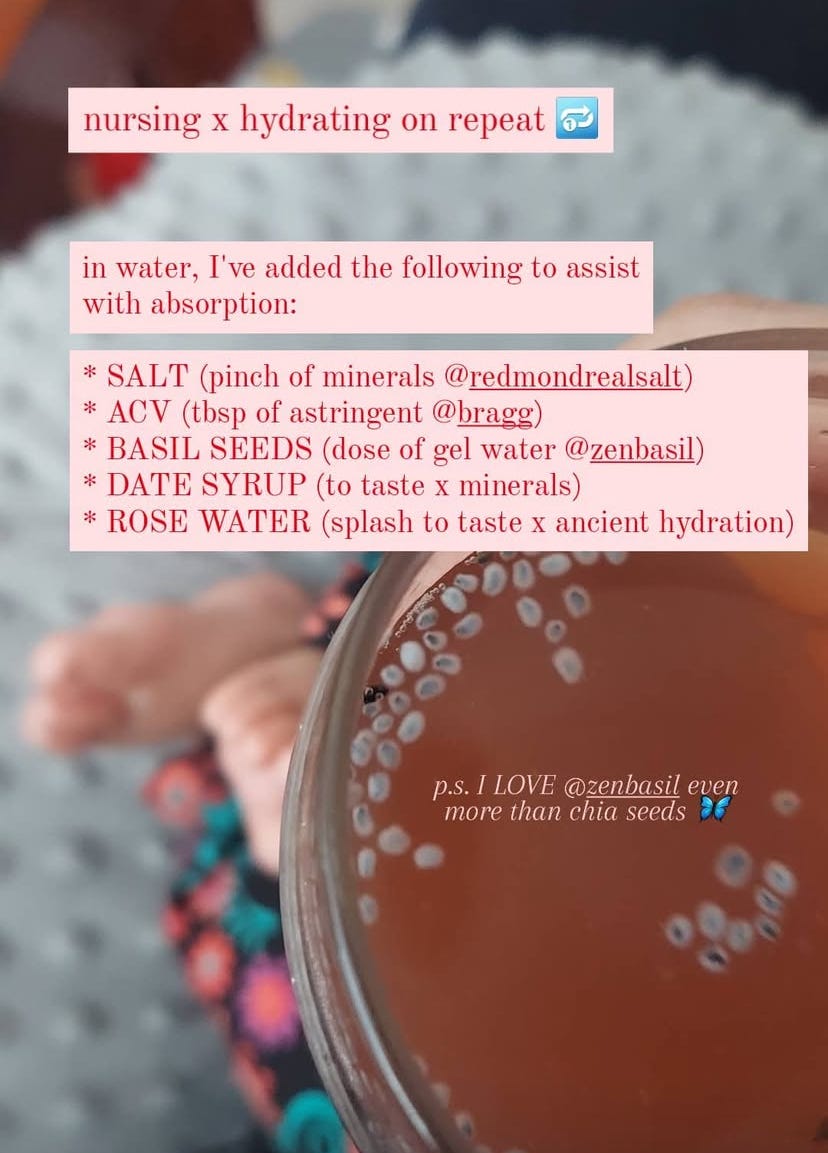
Basil seeds (sabja or tukmaria) are what I prefer here, and they’re worth knowing. Chia seeds have been popular for good reason, but basil seeds gel in 5-10 minutes versus chia’s 30, are considered cooling energetically (which matters during Ramadan’s heat and for a nursing body that already runs warm), and in Ayurvedic and TCM frameworks carry an affinity for calming heat in the gut. The cooling action is a real clinical consideration: basil seeds help moderate the internal heat signature that builds during dry fasting, which is likely why the Prophet SAWS would eat cucumbers (cooling) with dates (warming). Soak 1 teaspoon of basil seeds in 16oz coconut water or hibiscus tea and it’s ready by the time you finish preparing suhoor.
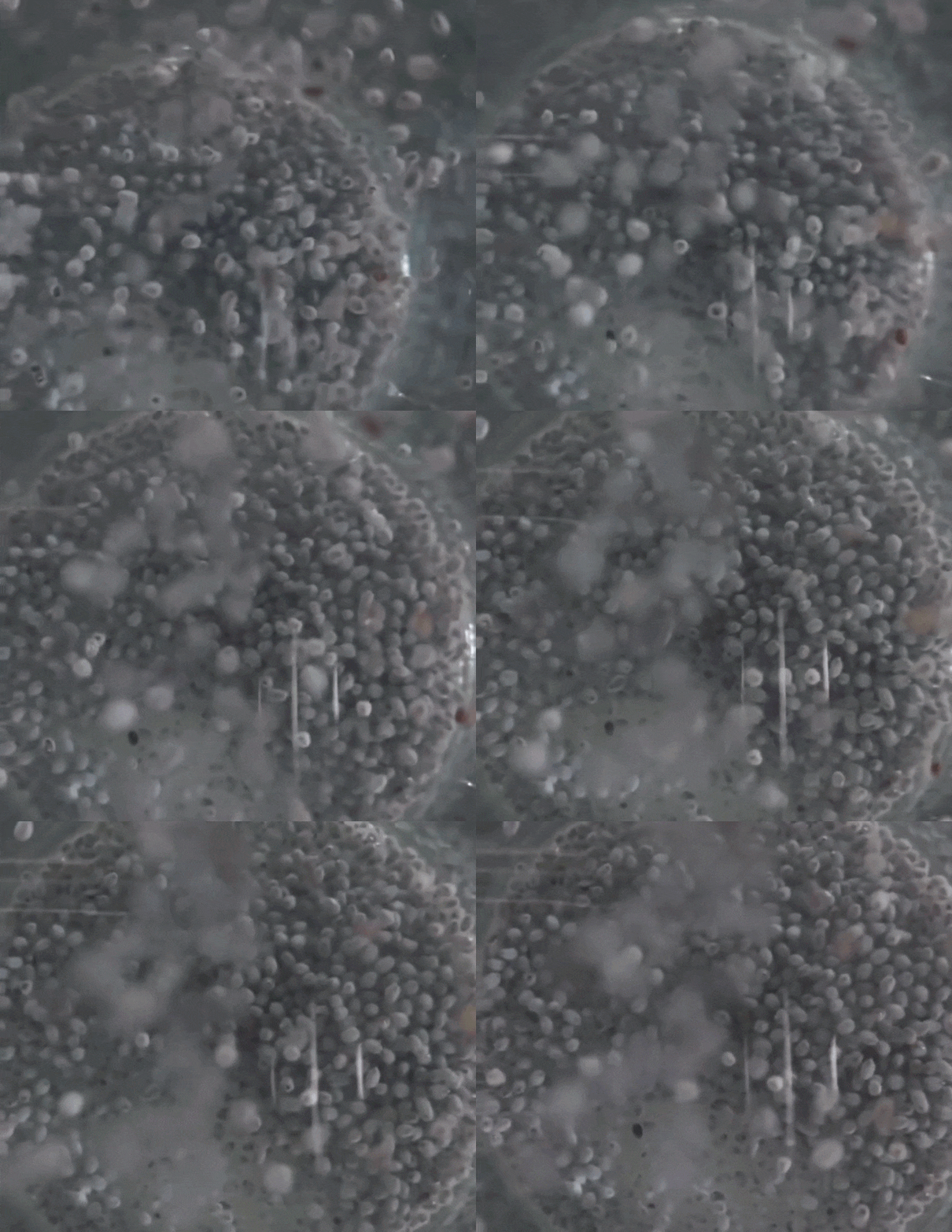
If you prefer chia, soak overnight. Both work. But for a body running warm and fasting in a season that carries lingering heat, basil seeds carry an edge. They’re also arguably easier on the gut for anyone who has ever felt bloated from chia seeds given the lower lectin profile. The possibilities are endless...
IV. Yin Nourishment at Suhoor
As dry fasting can create a yin-depleting state, what you eat at suhoor functions as pre-loaded medicine. You’re building reserves before the draw begins.
Yin foods moisten. They cool without extinguishing. They build Kidney + Liver + Lung yin ~ the deep fluids that sustain you across a long, dry day.
What to prioritize: soft pears (especially Asian pear), mung beans, lily bulb congee, black sesame paste, bone broth, steamed beets, cucumber, aloe vera juice, and mulberries. These are the foods classical texts reach for when yin is depleted. Add meyer lemons with the peel. Beets, chard, and carrots from the farmers’ market right now still carry soil memory.
A real suhoor might look like: warm congee with black sesame paste, a soft pear, a cup of bone broth with a mineral-salt pinch, basil seed coconut gel to drink, and a soft egg with a slice of avocado. Warm. Grounding. Slow-burning. You can supplement with whey protein and branch chain amino acids like Perfect Aminos for extra building-support. Something the body can draw from across ten or twelve hours.
Eat it seated. Say bismillah. Put the phone down. Digestion is a parasympathetic function that requires your nervous system to be in receive mode. Bolting through suhoor while checking your phone changes what that food does in your body. I’m not saying you do this; it’s a reminder for the lifestyle habits many of us have, and as always, these are reminders to myself.


V. Saffron + how I like to use it
I steep saffron in water most of the time because it’s convenient and water is fine for extraction. If I’m being precise though: I’ll add a tsp of olive oil to the water, let the threads sit inside the oil droplets, which pulls the fat-soluble compounds more efficiently. If you want maximum bioavailability, steeping in cold milk overnight in the fridge, then gently warming at suhoor, gives you both water-soluble and fat-soluble fractions. For a nursing mama in particular, the milk base adds yin nourishment on its own.
The science briefly: saffron’s active compounds, crocin and safranal, support mood (serotonin modulation), improve microcirculation, and carry anti-inflammatory properties. The effect is nothing like caffeine. It’s closer to a gentle warming of circulation from within. For the 4pm exhaustion in particular, the cumulative effect of saffron at suhoor becomes noticeable within several days.
A necessary note for nursing mamas: stick to 3-5 threads max. Culinary amounts. Saffron at high doses (we’re talking upwards of 5 grams daily, far beyond what you’d use in food) carries risk of uterine stimulation. At normal culinary use, this is well within safety. For true milk supply support, fenugreek, oats, nettle, and moringa have stronger evidence as galactagogues and are great at suhoor. Saffron supports you ~ the mood and circulation and warmth of the body doing the work. That matters enormously for a nursing mama fasting through Ramadan. Just keep it to a few threads.


Something worth sitting with here. Nursing mamas who fast carry a weight that has nothing to do with hydration. It’s the question underneath the question: am I doing this right? Am I harming her? Am I allowed to need things too? The spiritual discipline and the physiological reality can pull against each other, and the confusion of that is its own depletion. You’re allowed to hold both. The clinical layer below is for that holding.
What follows covers muscle preservation as hydration strategy, fascia protocols for when hydration advice stops working, the 4pm acupressure sequence, breastfeeding-specific timing within your feeding window, and two small practices that cost nothing and multiply in benefits. This is where context changes the prescription, especially if you’re depleted going in or managing supply concerns.
⟢ Continue reading below or upgrade here.
Membership gives you full access to essays like this and exclusive pieces, along with the Reset Room, our private discussion space where these conversations spark and deepen. The annual rate is locked in for those who join now.
Let’s continue. ♡
